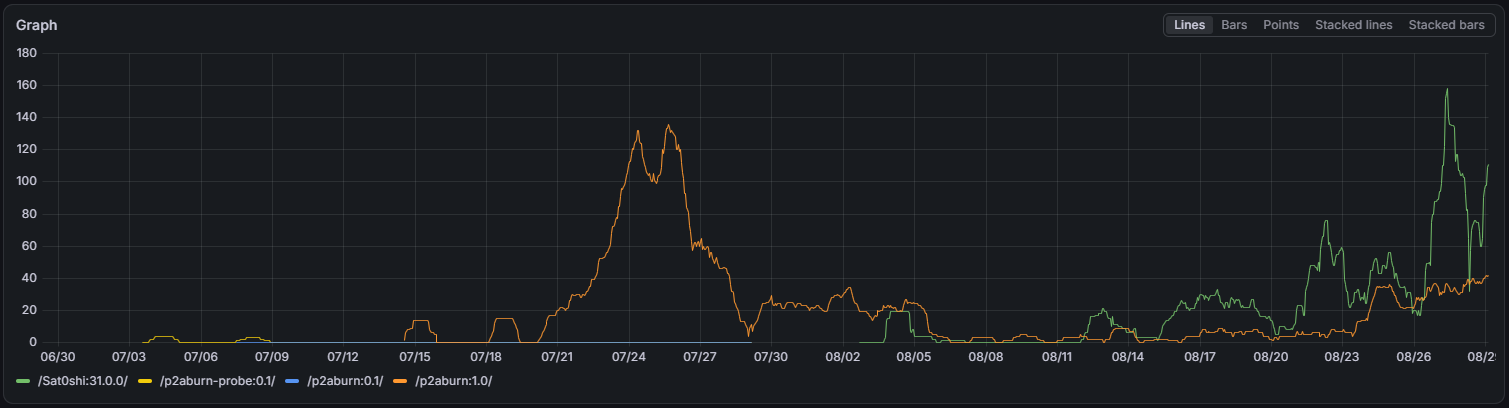
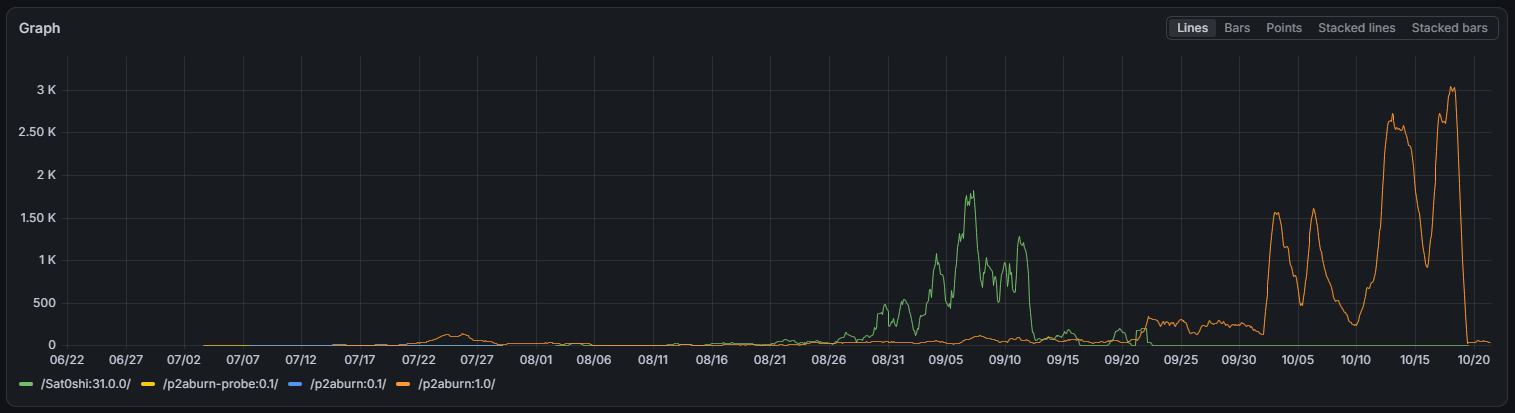
Yesterday, I took a look at those nodes appearing on my node running peer-observer, about 31.0.0 + ver 70015 and p2aburn*. The images below show a counter on how many connections those peers opened to us per day, for reference here is the promql that generated this:
sum by (useragent) (
increase(peerobserver_p2p_version_useragent{useragent=~"/p2aburn.*|/Sat0shi:31.0.0/"}[1d])
)
-
2026-07-03:
p2aburn“probe” first appearence; -
2026-07-14:
p2aburnnon-probe started to appear; -
2026-08-03:
Sat0shi:31.0.0first appearance; -
2026-09-22:
Sat0shi:31.0.0last appearance, in this metric I have no way to filter (also) per protocol (70015), so it stops there; -
2026-10-18: after some peaks,
p2aburnfalls to about 30~50 connections per day.
Now, based on logs (with a llm help), here it is the same data that also includes /Satoshi:31.0.0/ + 70015:
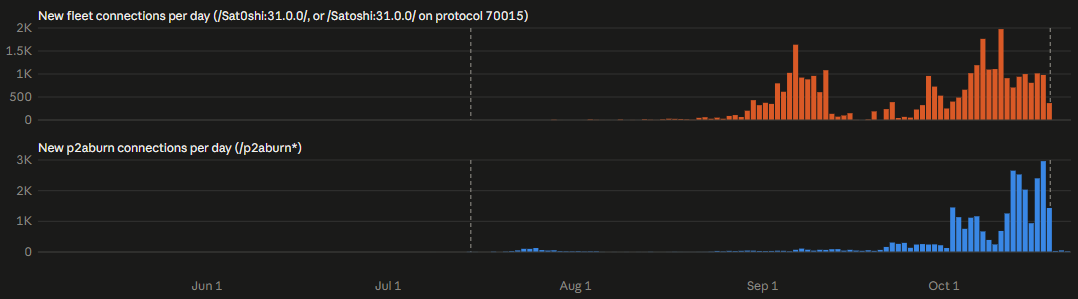
Note: dashed lines means, first 2026-07-14 (
p2aburnarrival) and the other is 2026-10-18.
Also, take a look at the volume of tx messages they were compared to the rest of the network:
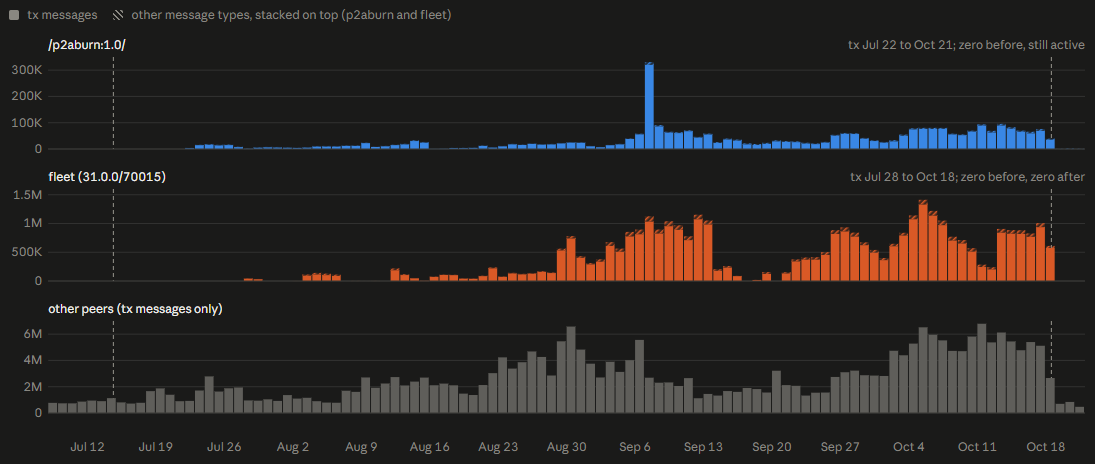
p2aburn still active but in a way lower volume than before, unlike fleet which is zero.
I didn’t see any of you mentioning it, but on 2026-10-18 many vps providers had rebooted their machines due to CVE-2026-99999 (including mine), see more at #189. I suppose the operators didn’t realize it yet, maybe at some point they will.
I see some sort of correlation with what’s happening with compact block reconstruction degradation as discussed in delving#1052, I’m still writing a BNOC’s post about it, your report gave me some insights, thank you @benunskilled and @stratospher!