Connection success rates
Knowing about the differences between the node configurations and the number of outbound connection attempts allows us to better understand the success rates of these attempts.
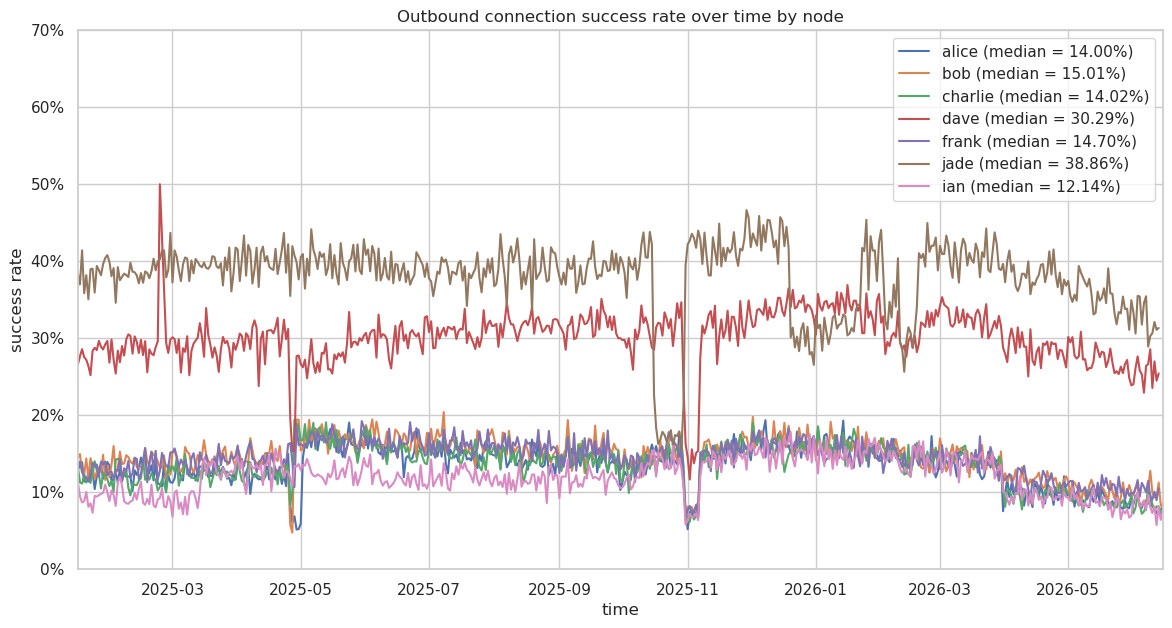
The nodes alice, bob, charlie, frank, and ian all have a similar success rate of 12% - 15%. Out of 57 attempts per hour, that’s about 8 new outbound connections (feeler included) per hour. Dave, which is also able to connect to Tor and I2P, has a higher success rate at 30% in median. Jade, which can also connect to IPv6, is closer to a median of 40% success. To better understand this, we can drill down by network and connection type.
By network
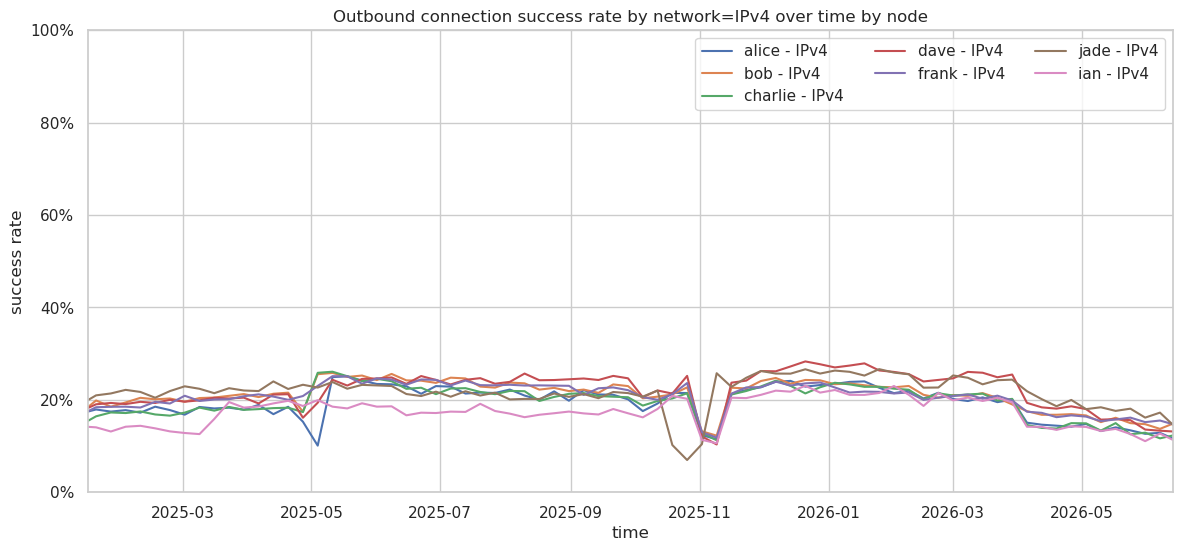
All nodes can make connections via IPv4. Between 2025-01 and 2025-03-31, the nodes averaged at about a 20% (or slightly more) connection success rate. Since 2025-04, when bitprojects ( Many connections to bitproject.io nodes? - #24 by bitprojects ) shut down their nodes, we’ve been seeing it dip below 20%. It’s closer to 15% now.
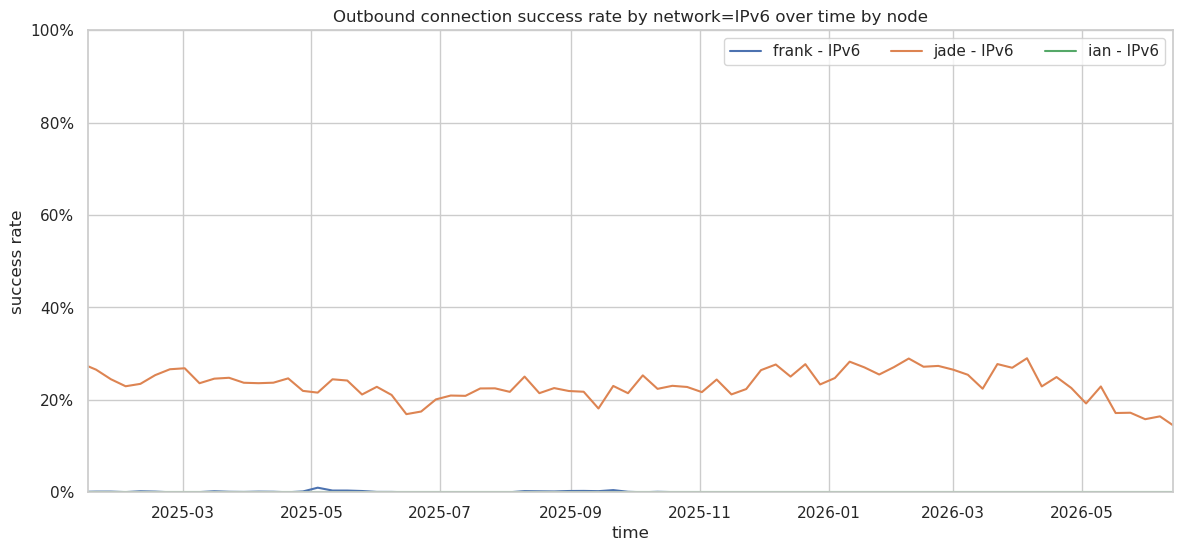
Only `jade` makes connections to IPv6. There, we have connection success rate just above 20%.
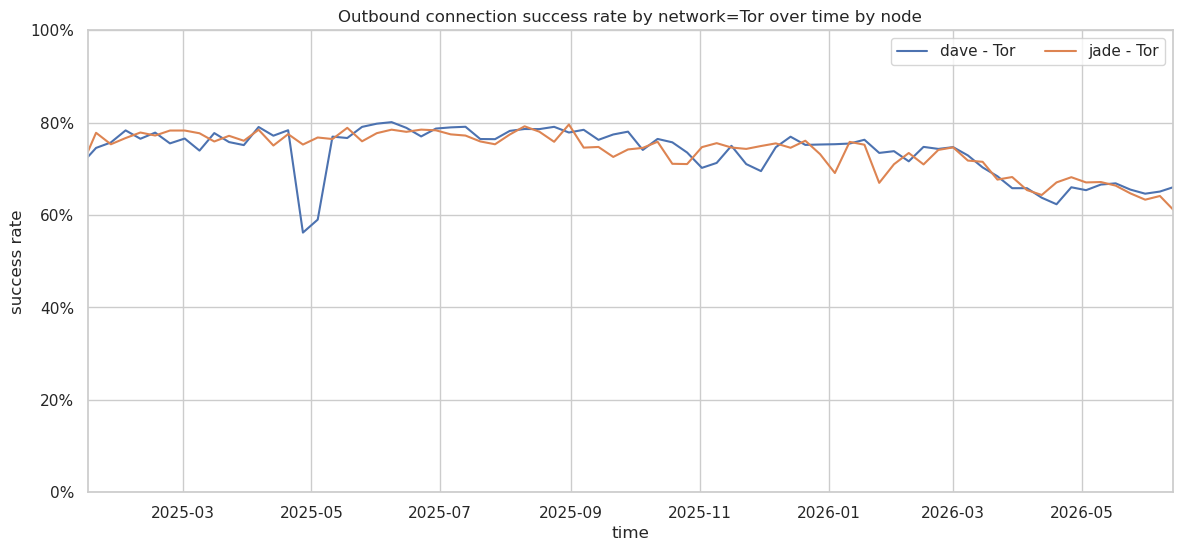
The rate for Tor on dave and jade dropped from just below 80% to about 65% since mid 2025 till mid 2026.
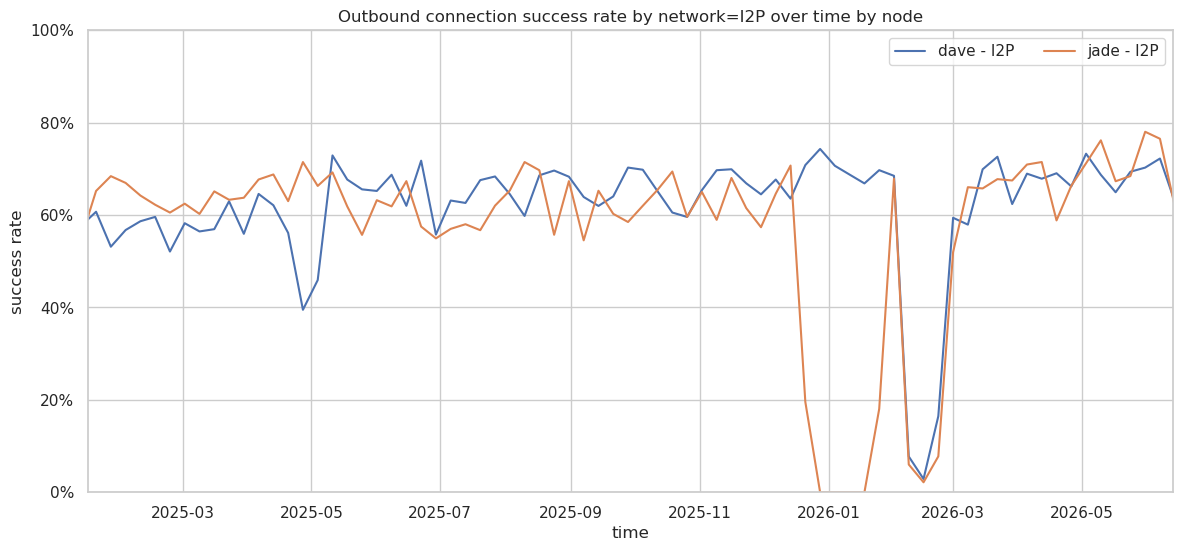
For I2P, the connection success rate averaged just above 60%. Both dave and jade had no success in connecting to I2P nodes during Attack on I2P: Bitcoin nodes not reachable via I2P in February 2026.
By connection type
For alice, dave, and frank, we have the success rate by connection type since April 2026 (due to net: extend log message to include attempted connection type · bitcoin/bitcoin@67696b2 · GitHub ; see above).
For all three nodes, the outbound-full-relay connections have a success rate of about 5%. On alice and frank, who can both only connect to IPv4, this matches with the feeler connections. However, on dave, the feeler connections have a much higher success rate at above 30%. On explanation for this is the high Tor and I2P success rate we’ve seen on dave. However, block-relay-only connections have a much higher success rate than the outbound-full-relay we are making. For alice and frank, about 20%-30%, and for dave about 40%.
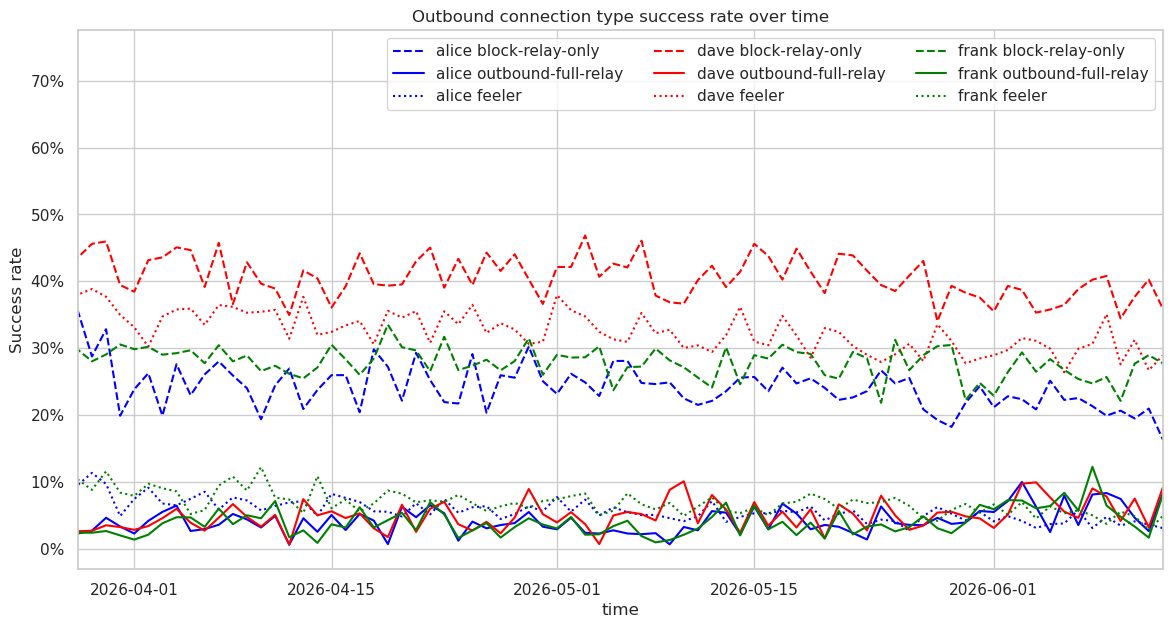
At first, this was confusing to me: block-relay-only connection success rates should not differ so much from outbound-full-relay success rates, as we select from the address manager tried table for both (as opposed to selecting from the new table for feelers).
By network and connection type
Looking at, for example, the success rate of alice’s IPv4 connections, shows that both block-relay-only and outbound-full-relay connections share the same ~25% percent success rate. At the same time, feelers are only successful at less than 10% of the cases in early April 2026 and less than 5% successful in June 2026 (I suspect this is related to the ongoing address message spam covered in /python-bitcoinlib:0.12.2/ client getting addr-ratelimited (since 2026-04-10) - #6 by b10c ).
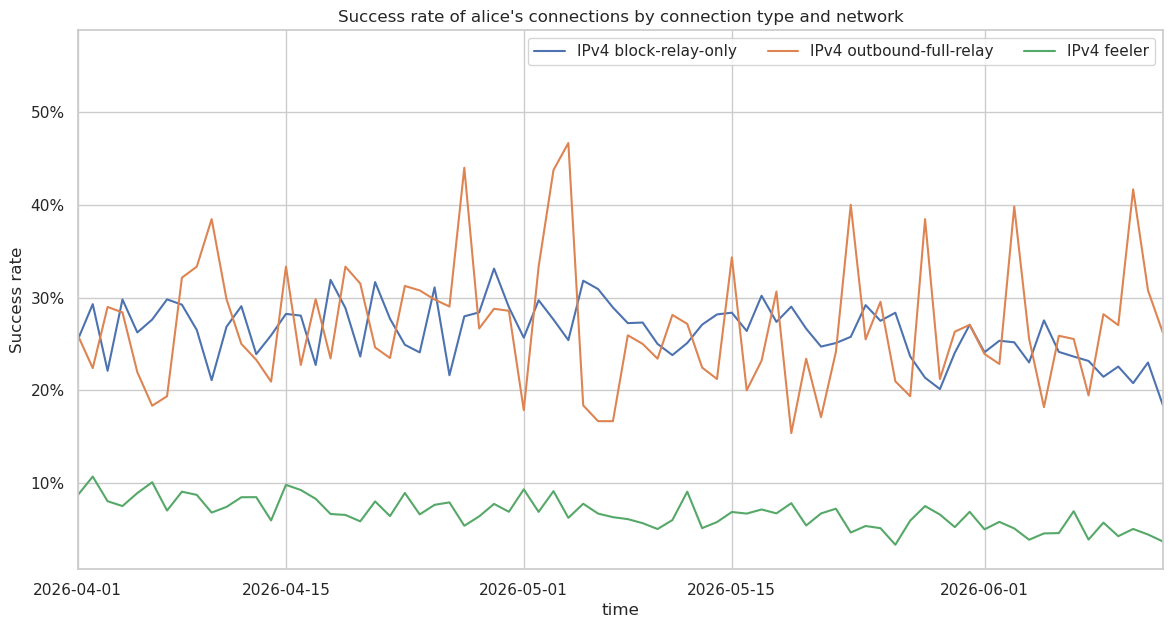
All attempts of alice to connect to IPv6 fail (not shown here). This helps to explain why the success rate of block-only and full-relay connections differ:
As discussed in Outbound connection success rates of a Bitcoin node - #2 by b10c , Alice makes about 3 IPv4 full-relay attempts at a ~25% success rate. It also makes 12.5 IPv6 block-relay-only connections to IPv6 with a 0% success rate. This means, maybe 3/4 out of 15.5 (or about 5%) of outbound-full-relay attempts succeed.
For block-relay-only, it’s 12.5 IPv4 attempts per hour with the same 25% success rate, and 3 IPv6 attempts per hour that always fail. That’s 3,125 connections per 15.5 block-relay-only attempts that succeed (or about 20%).
Both of these match what we’ve seen before in the “By connection type” section during the last few months.