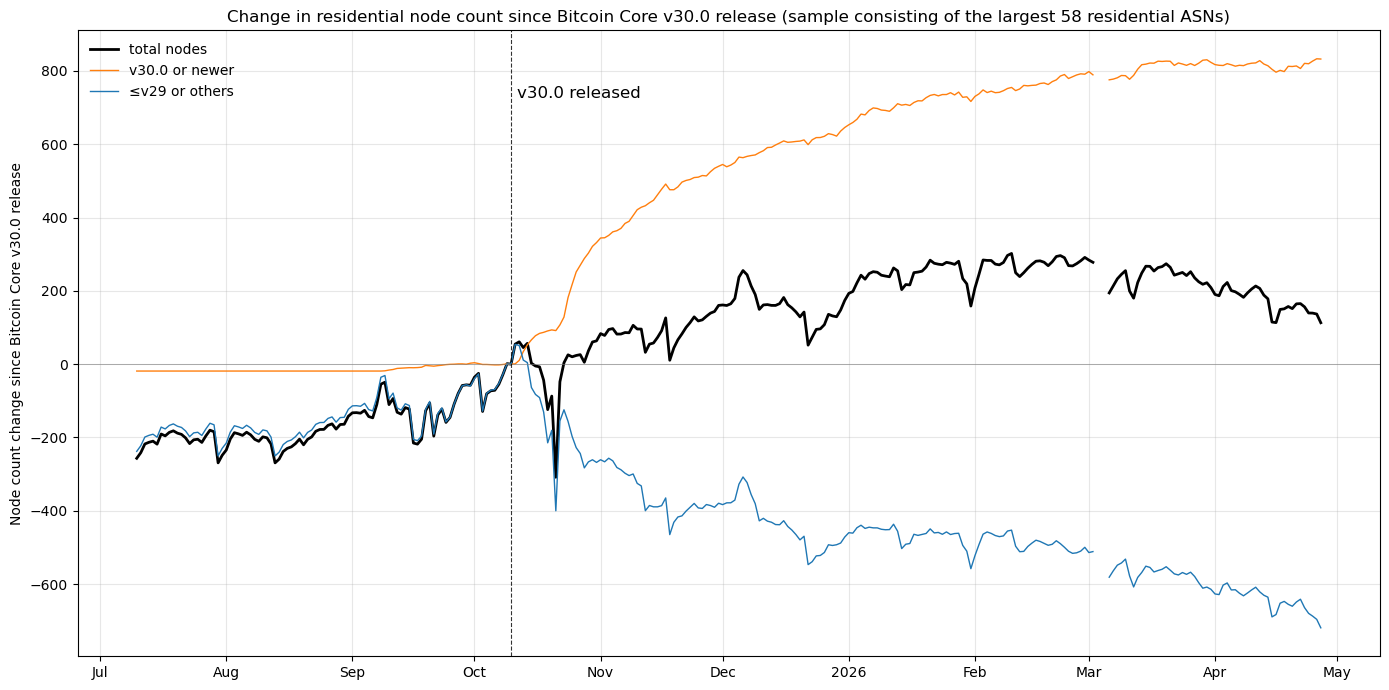
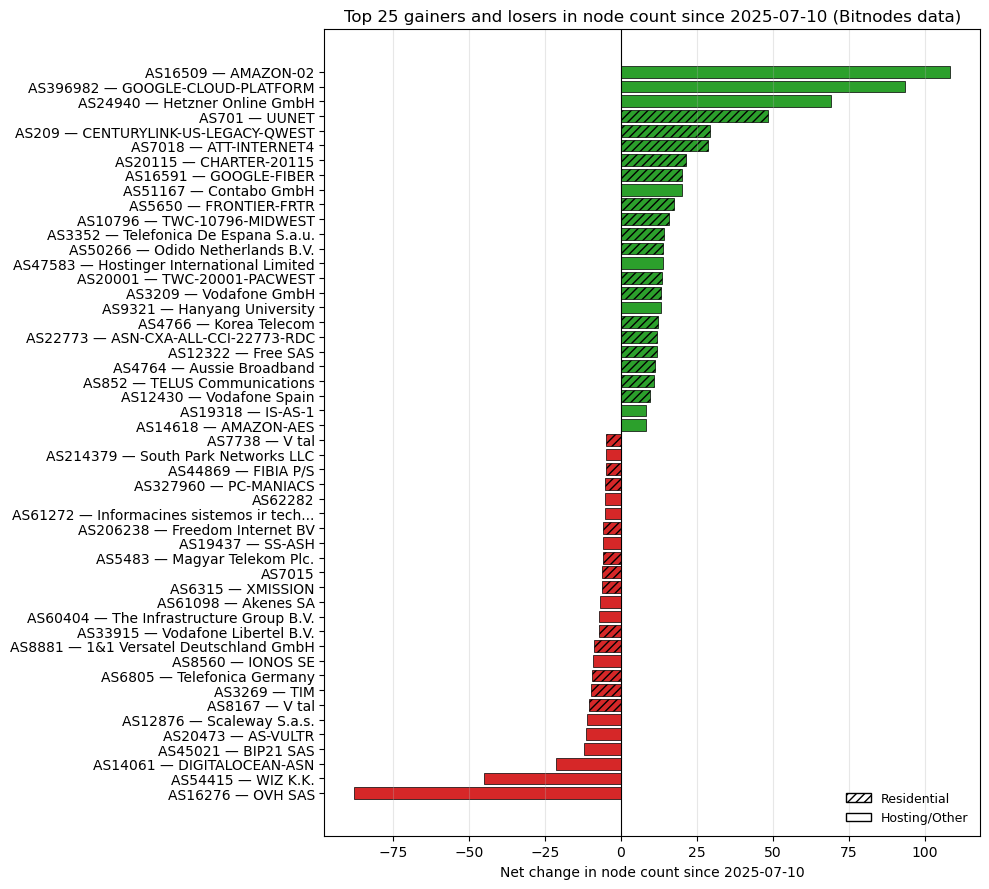
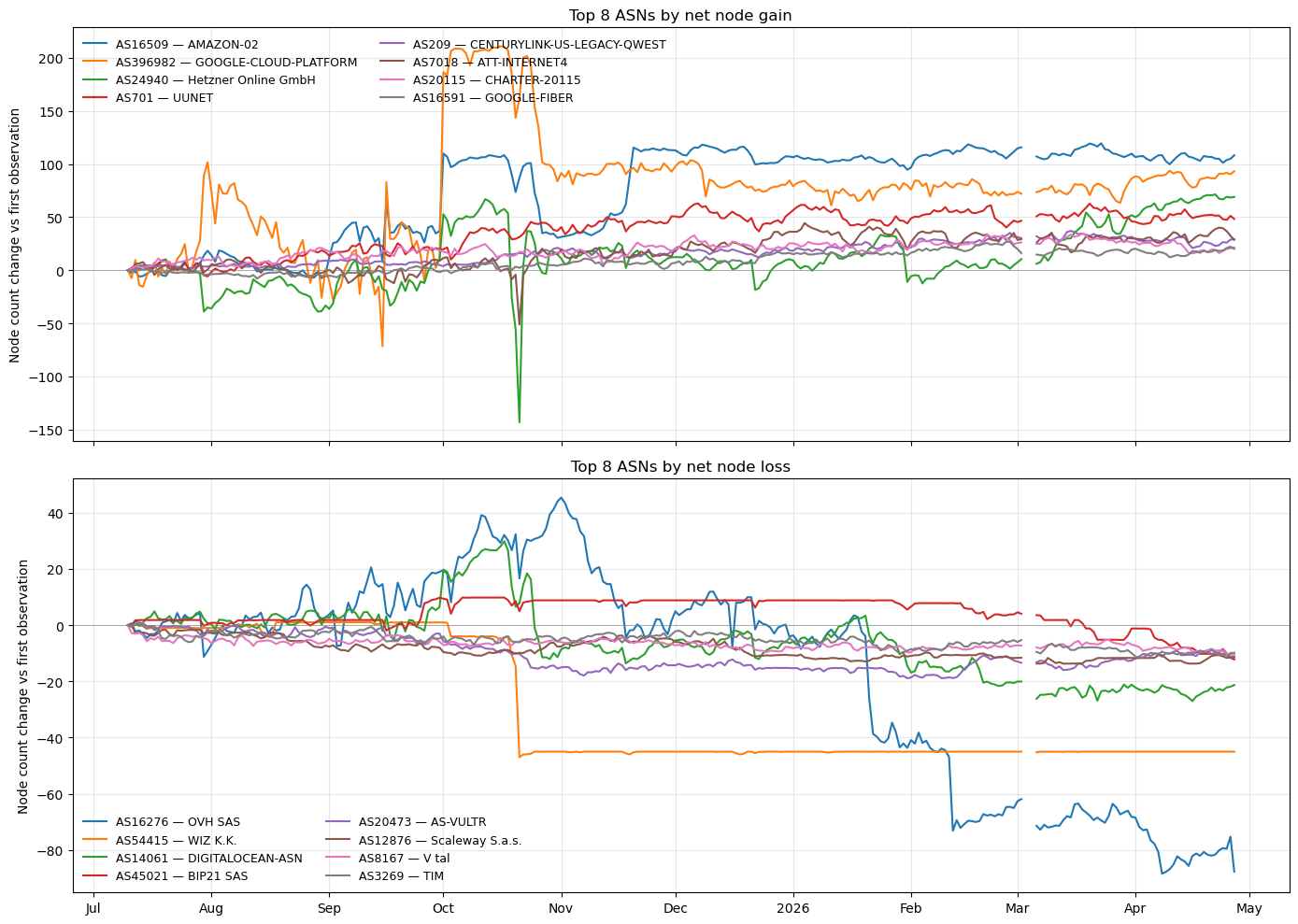
To explore if this change had a measurable effect on the network, I’ve looked at the historical network snapshots captures by bitnodes.io. Particularly, I’m looking at 36310 snapshots from 2025-07-10 till 2026-04-27 that I’ve archived. To map IPs to ASNs, I’m using 2026/1772726400_asmap.dat. I’ve manually classified the ASNs with 25 or more nodes into either “cloud/hosting” or “residential/ISP”. This yields 58 “residential” ISPs. I’m counting both IPv4 and IPv6 addresses as distinct nodes, which likely inflates the numbers a bit, as likely some residential nodes listen on both IPv4 and IPv6.
ASN classification
hosting = [
    "AS24940", # Hetzner
    "AS16276", # OVH SAS
    "AS16509", # Amazon 02
    "AS396982", # Google Cloud Platform
    "AS14061", # Digital Ocean
    "AS51167", # Contabo
    "AS40021", # Contabo
    "AS141995", # Contabo Asia
    "AS8560", # IONOS SE
    "AS14618", # Amazon.com, Inc.
    "AS197540", # netcup GmbH
    "AS20473", # Vultr
    "AS31898", # Oracle
    "AS12876", # Scaleway SAS
    "AS6939", # Hurricane Electric
    "AS63949", # Akamai Connected Cloud
    "AS54415", # Wiz (mempool space)
    "AS47583", # Hostinger
    "AS9009", # M247 Europe SRL
    "AS19318", # Interserver

    "AS1299", # Arelion Sweden AB (not sure)
    "AS45021", # BIP21 SAS (not sure)
]

residential = {
    "AS3320": "Deutsche Telekom AG (DE)",
    "AS3209": "Vodafone GmbH (DE)",
    "AS4766": "Korea Telecom (KR)",
    "AS7018": "AT&T Enterprises (US)",
    "AS701": "Verizon Business (US)",
    "AS12322": "Free SAS (FR)",
    "AS20115": "Charter Communications 1 (Spectrum; US)",
    "AS20001": "Charter Communications 2 (Spectrum; US)",
    "AS11427": "Charter Communications 3 (Spectrum; US)",
    "AS10796": "Charter Communications 4 (Spectrum; US)",
    "AS33363": "Charter Communications 5 (Spectrum; US)",
    "AS11351": "Charter Communications 6 (Spectrum; US)",
    "AS11426": "Charter Communications 7 (Spectrum; US)",
    "AS5650": "Frontier Communications of America (US)",
    "AS22773": "Cox Communications (US)",
    "AS1136": "KPN (NL)",
    "AS209": "CenturyLink Communications (Lumen; US)",
    "AS852": "TELUS Communications  (CA)",
    "AS16591": "Google Fiber (US)",
    "AS3303": "Swisscom (CH)",
    "AS2856": "British Telecommunications (UK)",
    "AS3215": "Orange (FR)",
    "AS5089": "Virgin Media (UK)",
    "AS577": "Bell (CA)",
    "AS3352": "Telefonica De Espana (ES)",
    "AS33491": "Comcast Cable Communications 1 (US)",
    "AS7015": "Comcast Cable Communications 2 (US)",
    "AS33650": "Comcast Cable Communications 3 (US)",
    "AS33651": "Comcast Cable Communications 4 (US)",
    "AS33652": "Comcast Cable Communications 5 (US)",
    "AS33657": "Comcast Cable Communications 6 (US)",
    "AS20214": "Comcast Cable Communications 7 (US)",
    "AS33668": "Comcast Cable Communications 8 (US)",
    "AS33490": "Comcast Cable Communications 9 (US)",
    "AS6730": "Sunrise GmbH (CH)",
    "AS6327": "Shaw Communications (CA)",
    "AS50266": "Odido Netherlands (NL)",
    "AS4764": "Aussie Broadband (AU)",
    "AS6128": "Cablevision Systems Corp. (US)",
    "AS7545": "TPG Telecom (AU)",
    "AS8473": "Bahnhof AB (SE)",
    "AS33915": "Vodafone Libertel (NL)",
    "AS20055": "Wholesail networks (US)",
    "AS812": "Rogers Communications Canada (CA)",
    "AS8881": "1&1 Versatel GmbH (DE)",
    "AS57269": "Digi Spain Telecom (ES)",
    "AS8708": "Digi Romania (RO)",
    "AS5410": "Bouygues Telecom (FR)",
    "AS1221": "Telstra Limited (AU)",
    "AS8151": "UNINET (MX)",
    "AS9318": "SK Broadband Co Ltd (KR)",
    "AS16019": "Vodafone Czech Republic (CZ)",
    "AS5378": "Vodafone Limited (UK)",
    "AS13030": "Init 7 (CH)",
    "AS28573": "Claro NXT Telecomunicacoes (BR)",
    "AS12874": "Fastweb SpA (IT)",
    "AS49981": "WorldStream B.V. (NL)",
    "AS6871": "Plusnet (UK)",
}
To get a rough feeling, I used the number of reachable residential/ISP nodes on 2025-10-10 (v30.0 release) as a baseline. A sharp increase in residential node count after this date could indicate that this change worked.
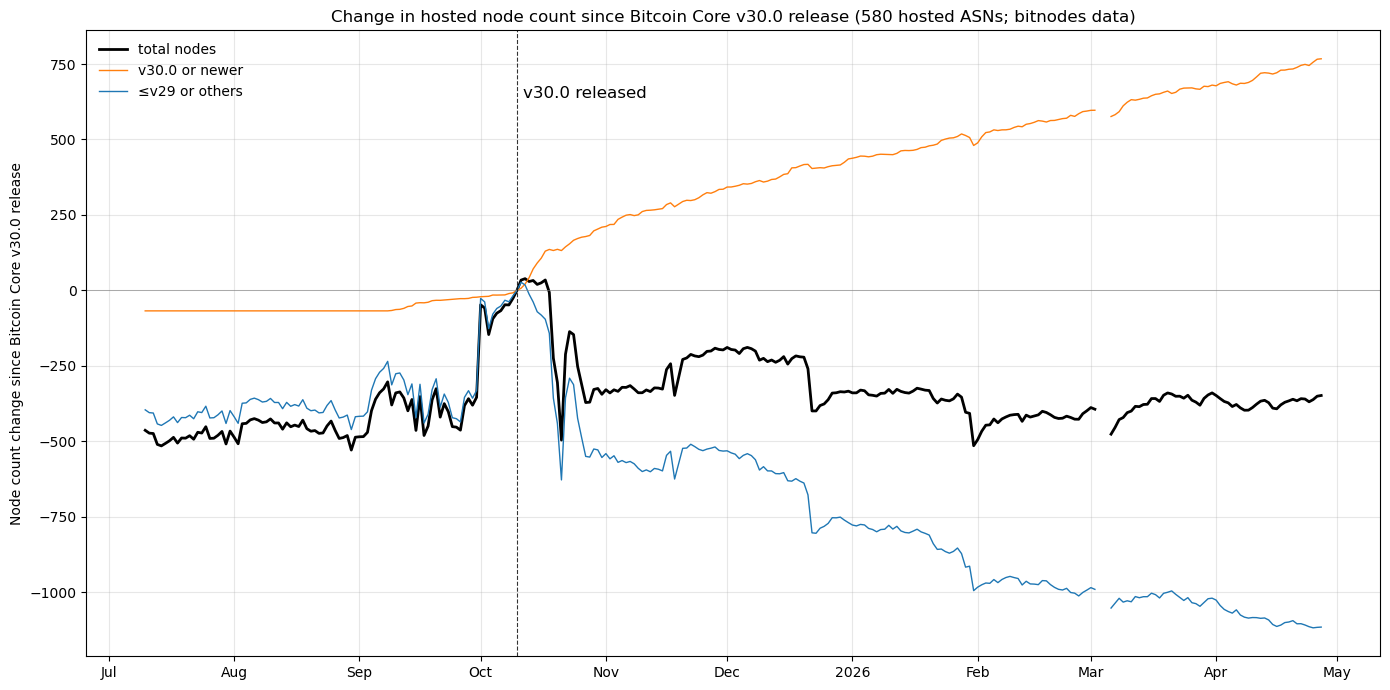
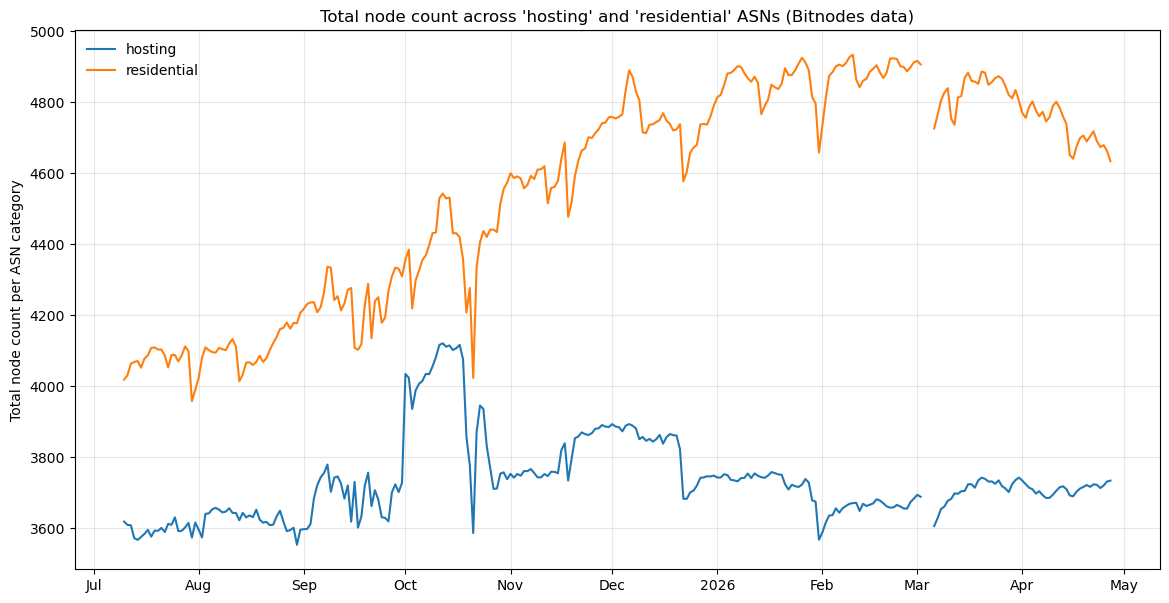
Plotting the change in total residential node count (black), change in v30.0 or newer nodes (orange), and change in ≤ v29.x or other node (e.g. Knots) count (blue) shows a total increase of about +100 residential nodes since Bitcoin Core v30.0 release. The orange line shows the adoption of Bitcoin Core v30.0 (+800), while the blue line shows a decrease in users running ≤ v29 or others (about -700).
While +100 residential nodes since Bitcoin Core v30.0 release is nice, this is far from the sharp increase in residential nodes some hoped for. Additionally, this likely can’t be attributed to -natpmp and rather follows a general trend. The plot shows that between August and the Bitcoin Core v30.0 release about +200 residential nodes joined the network in the observed ASNs. This might be due to the Core/Knots debate, the price rally during late 2025, more podcasts or tutorials explaining users how to run a node, or more users buying a plug-and-play node.
My current conclusion is that enabling -natpmp=1 by default didn’t cause an increase in residential nodes.
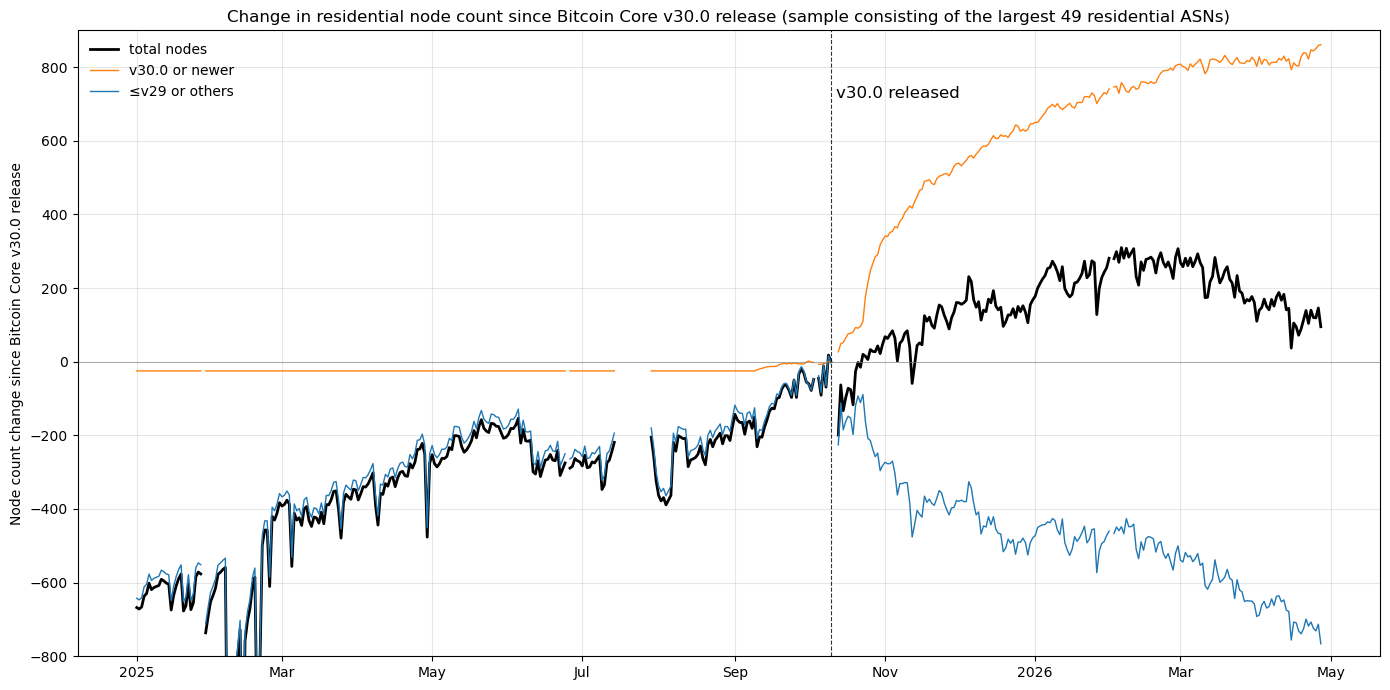
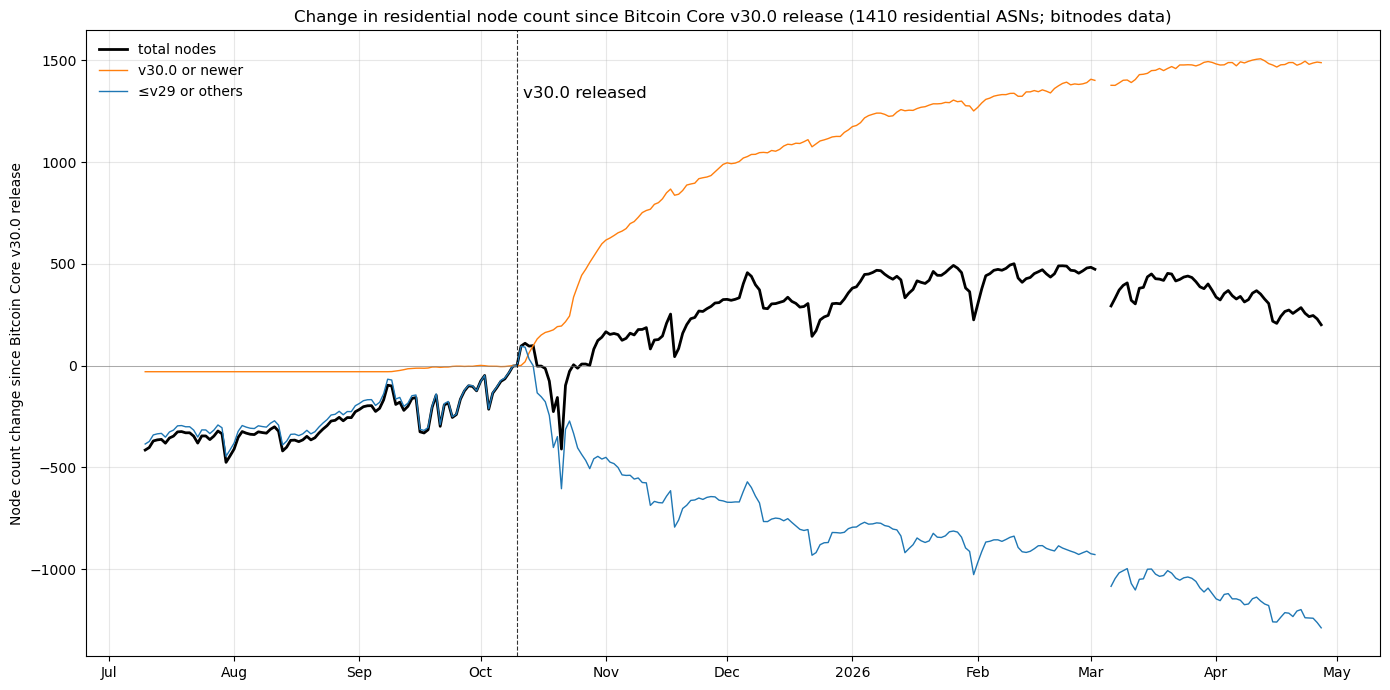
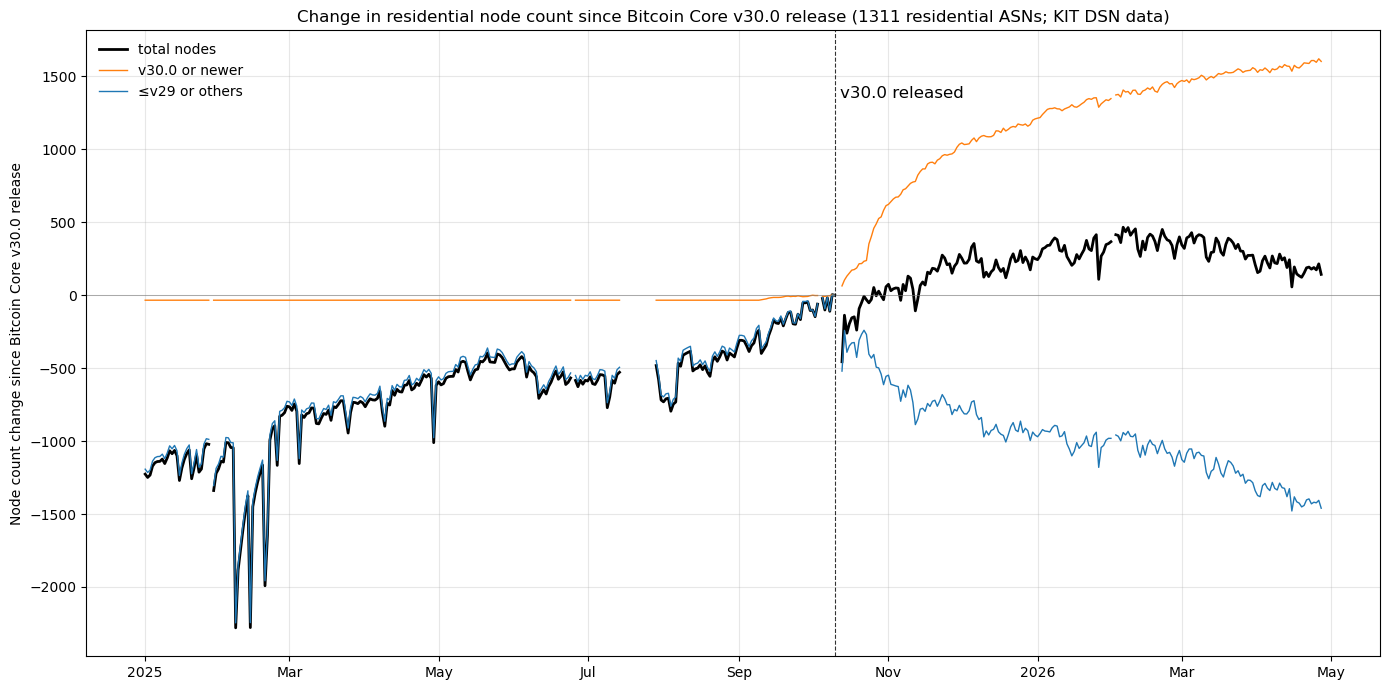
Further work could inspect this separated by IPv4/IPv6, use the KIT DSN network snapshots to cross-check the numbers, or investigate how many not-seen-before IPs appear the first time with a v30.0 user-agent.