edit (@b10c): the title was originally “/Satoshi:29.1.0(dont-spam-me-bro)/ nodes?”.
Noticed these connections on both my outbound and inbound direction on various nodes: “/Satoshi:29.1.0(dont-spam-me-bro)/”
They appear to behave fairly normally, relaying 0-fee TRUC transactions in a package (precluding stock Knots 29.1), but I don’t know anything else about them.
I noticed I have two of my outbound slots of len (demo.peer.observer) connected to them. instagibbs mentioned to me he has 3 of his outbound slots connected to them on one of his nodes. This is worrying, as filling outbound slots should be hard to avoid eclipse attacks.
I’m not sure ASMap would be a substantial improvement over the current /16 mechanism. There is 10 peers to choose from 10k /16’s available. That’s roughly a (n / 10_000)^10 probability to connect to an attacker controlling n /16’s.
That said, it seems that it’s not what happens in practice. The Bitprojects guy controls only 12 /16’s. That a node would pick any of those 12 for 4 of its slots if it has heard about all /16’s available is essentially null. Could it be that somehow he found a way to bias DNS seeds towards his nodes, such as a node joining the network does not hear about many more /16’s than his?
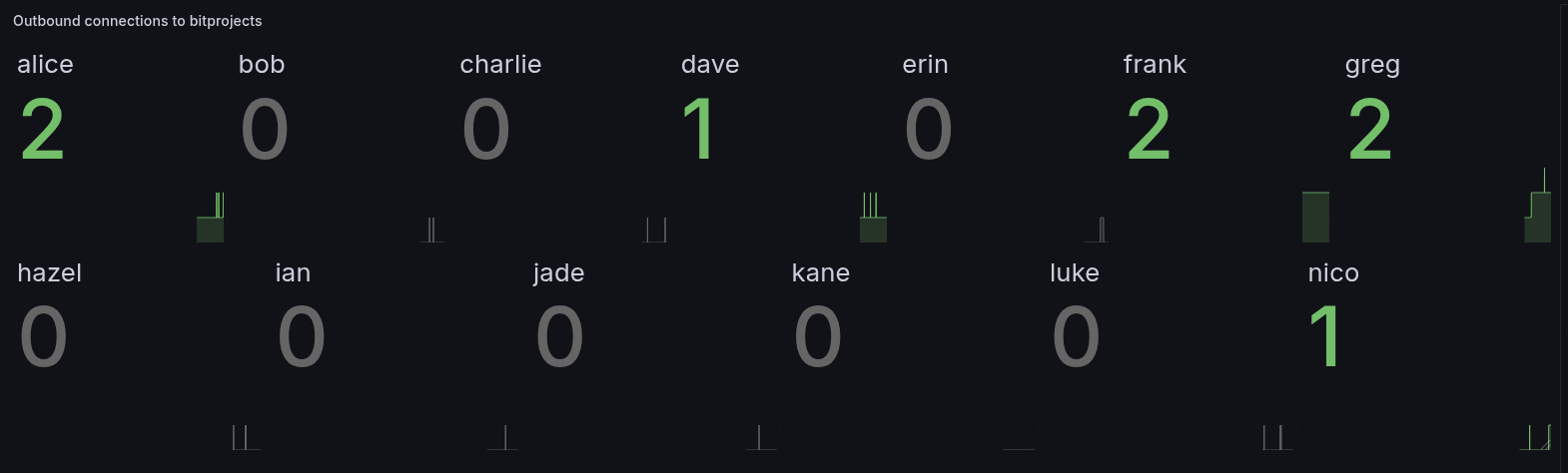
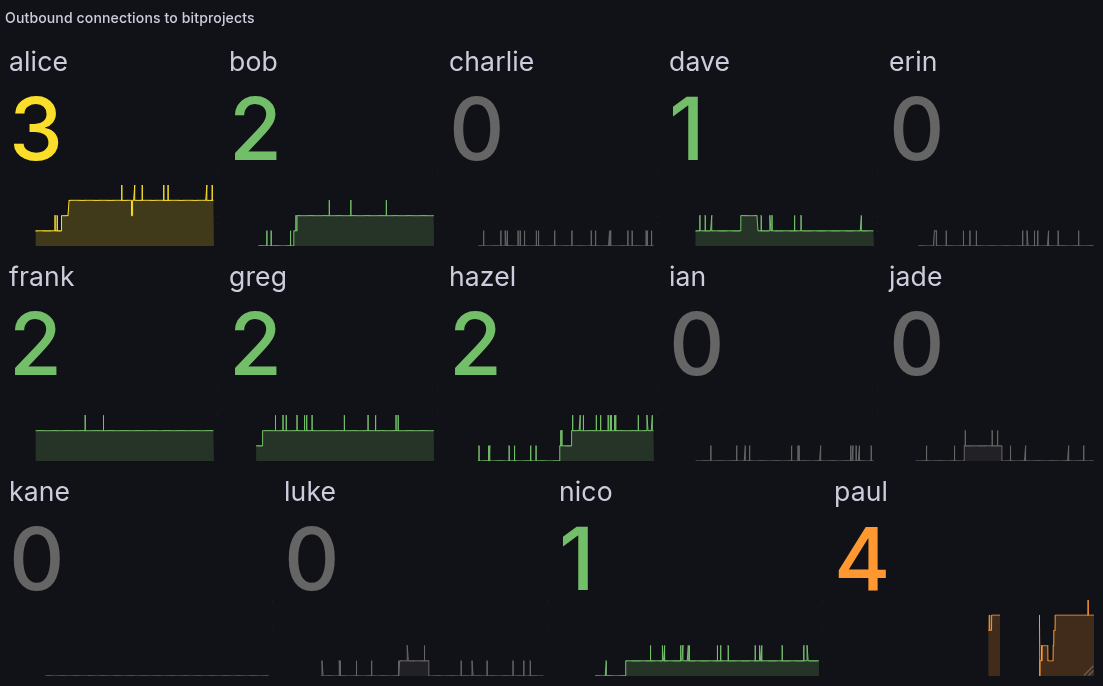
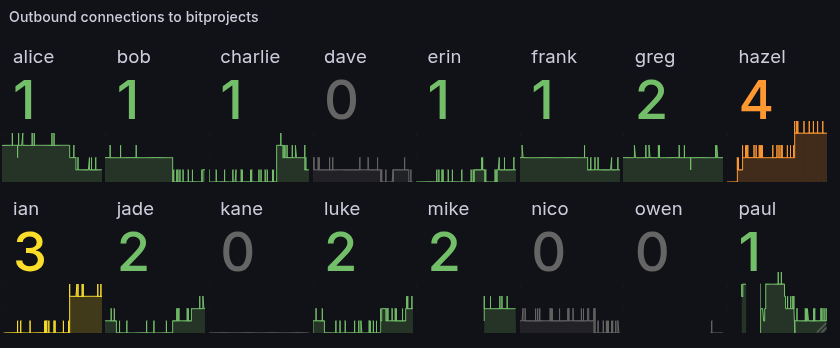
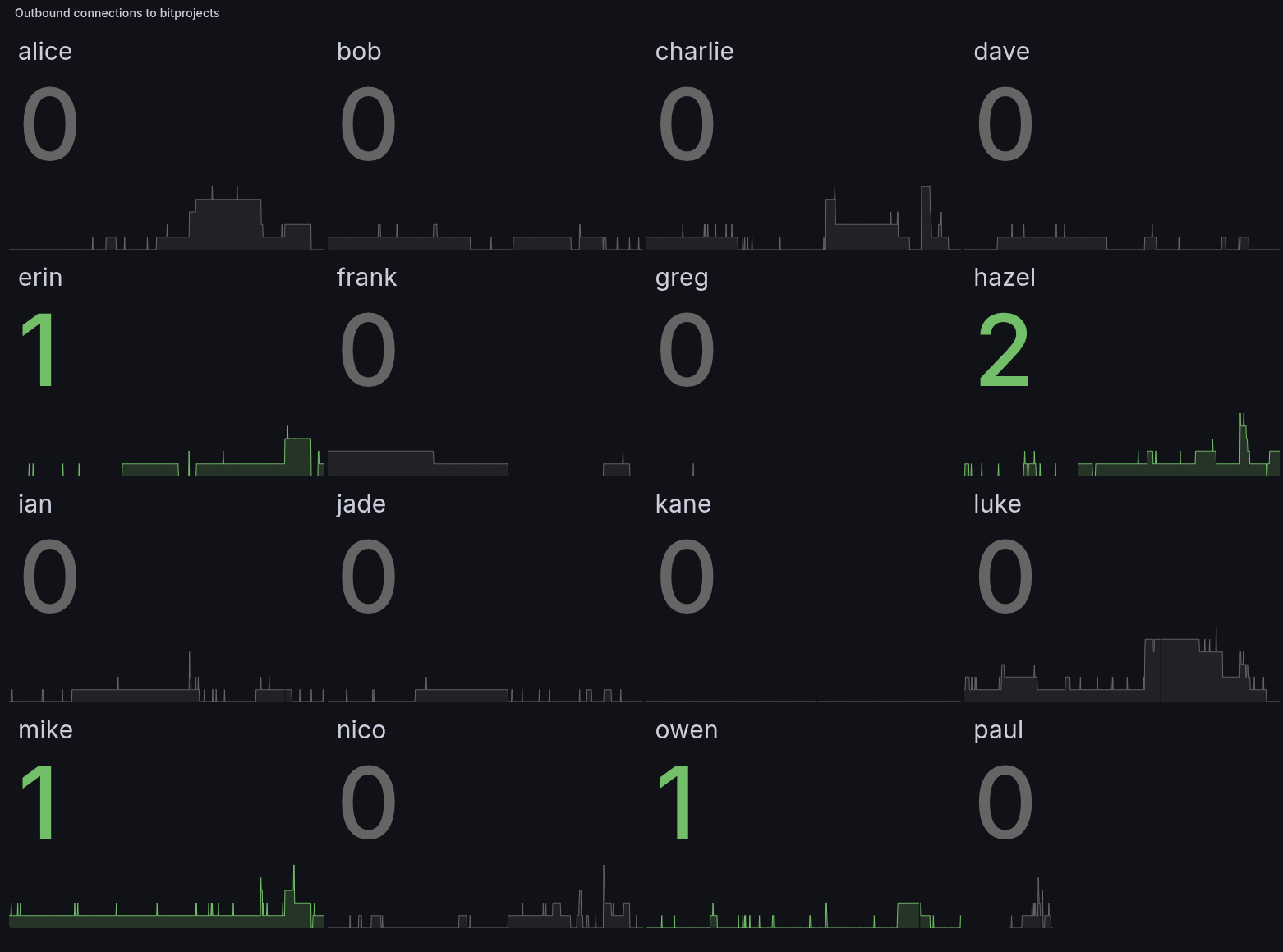
I’ve set up some data collection on the number of outbound connections I have to the bitproject IPs (also inbound, but don’t seem to have gotten any inbounds from them).
Currently, three of my nodes have two of their outbounds to bitprojects:
Or maybe his addresses get rumoured a lot more? If the addresses a node will return to a GETADDR are randomly sampled among all known addresses, instead of first sampling by /16, then it seems that his nodes would be overly represented.
We don’t sample based on /16 - we sample based on address (and abort/get another sample if another outbound is from the same range). For example, if we have an addrman with 99 addresses from /16 range A and 1 address from /16 range B, we’ll pick an addr from A for our first peer with 99% probability.
So controlling a large number of addresses from a given /16 range does increase chances of being picked even if other nodes will only make one connection to that range.
I discussed this with a few people out of band, but just to share here this explains why we are seeing so many peers connect to the Bitprojects guy. My previous assumption on how this logic works:
Was incorrect, as Martin explained above. So it seems that if he was controlling just a few more /16’s, as well as a few thousands more “node” IPs then he would have a decent chance of eclipsing a node.
I find it surprising that AddrMan doesn’t work the way i expected it to, because it would make the probability of controlling all of a node’s outbound connections decrease exponentially in the number of connection slots. As far as i understand (and what i got from a quick discussion at the office) this is due to architectural limitations in AddrMan’s implementation. I’ve started looking into what it would take to implement what i suggest.
So it seems that if he was controlling just a few more /16’s, as well as a few thousands more “node” IPs
FWIW, getting control of a /16 and all its IPs costs millions of USD. But using IPv6 should make this much easier to scale.
This seems quite problematic and defeats almost any gains asmap affords?
Why would it defeat all the gains? You can easily get hundreds of IPs across 13 different /16 on AWS or any other larger hoster. Getting many ASNs and making hundreds of IPs available through them is a much higher bar. Also, there are less than 100k ASNs in use in global routing and getting a large number of them without a legitimate use-case would a considerable bureaucratic hurdle.
The issue is that with the current peer selection algorithm you don’t need a large number of them, just as many as we make outbound connections by default, or slightly more. The bitprojects guy already controls 12 /24’s spread across /16 boundaries and 3 or 4 AS’s. It does not seem completely unrealistic to me that he would be able to spin up a large number of (maybe fake) nodes in more than 10 net groups (either /16’s or AS’s).
And I am saying that 10 is a large number for ASNs at least relatively speaking. There are 2^96 /32s in IPV6 almost all available to use if you just put down a little bit of money.